Hout Bay is one of those dorpies. Somehow it is not quite what it seems. It reminds me a bit of that long-awaited heir that is born. The Crawly -Smiths will claim that he has Grandpapa’s high forehead, and the Dr. & Mrs. Wilson Stevens will snugly comment on his intelligent little eyes. And then, 3 years later, little Lord Crawly-Smith will strut around with his little Noddy nose and ginger curls, and everyone will wonder exactly how and where the little mite fits in. Hout Bay is like that.
Originally, the area was inhabited by Khoi Khoi. They were the tail end of the stone age people who inhabited the area a long time ago when wooly mammoths were sure to still roam the earth. The Khoi Khoi are sometimes referred to as “Strandlopers”, which is a reference to them gathering food on the seashore. Apart from gathering food, they also kept herds of sheep and cattle, and this made them the original shop keepers of the southern tip of Africa. Their currency in trading, was brass, copper and tin.
When John Chapman in 1607 got his ship into trouble, he cautiously explored in the bay which we now know as Hout Bay. He made sure not to stray too far from his ship, as the rolling mist would have had him going in circles trying to find his way back. It was an unknown and wild country, inhabited by short people, with pepper corn hair and slightly yellow complexions. Before you judge the poor Mr. Chapman, please keep in mind what your reaction would be to spindly green men with triangular faces and only one eye, stepping from a giant saucer. The land, however, had plenty tall trees and all the wood needed to repair ships. History has been kind to this John Chapman. That very famous, ever so beautiful Chapman’s Peak drive bears his name. That is far more of a legacy than any of us could ever hope for. Hout Bay was first called Chapman’s Chaunce, it was the first ever English name to appear on a map of Southern Africa. Chaunce, by the way, is an old English word that means an especially random event or occurrence.
It took another 45 years before anyone had the bright idea of establishing a trading station and subsequent settlement at the Cape. By 1668, the first permits were issued for wood to be cut at Hout Bay. Manganese was discovered in 1873, and by the time 1904 rolled by, fishing had been established in Hout Bay. And this is where the story of Hout Bay and young Crawly-Smith connects. What Hout Bay set out to be, and where it ended, is 2 completely different paths. Today, no one travels to this lovely little town to barter a brass ring for a sheep, you will not be repairing your car with a wooden pole, and the economy no longer relies on fishing. Unless you are a seal. Seals fish as if their lives depend on it.
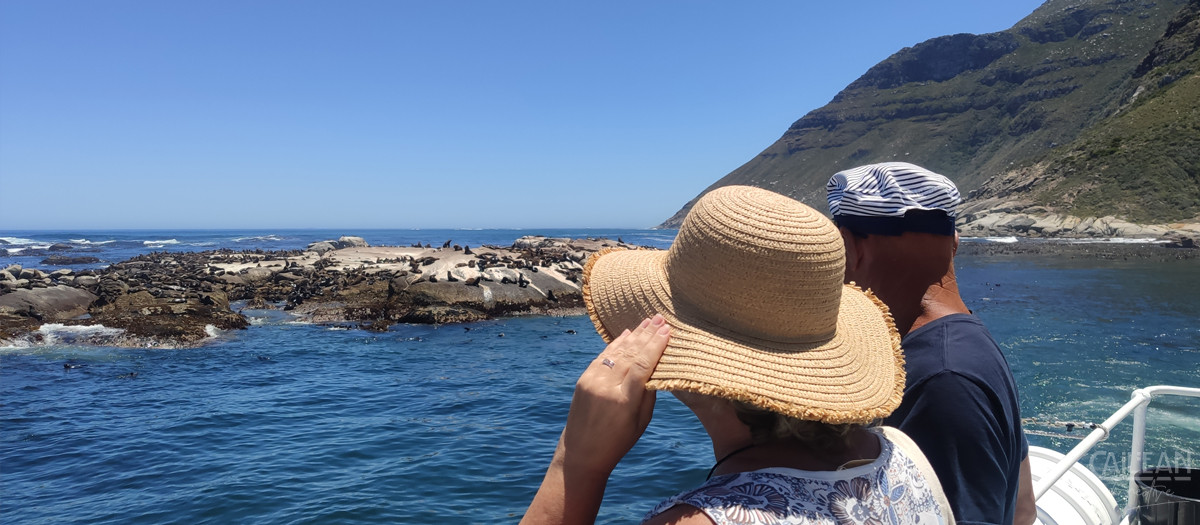
Today’s traveller will purposely detour to drive along the very scenic Chapman’s Peak. Your first glimpse of Hout Bay harbour will take your breath away. The seals frolicking in the water will have you going “Awwww! How cute.” You will pay for your ticket to go out on one of the many tourist boats that take you to Duiker Island. Now this is a rocky bit of outcrop in the middle of the sea. It is named for a bird (duiker) but is mostly covered in very fat and furry seals. As always, you smell them, before you see them. But like so many of the ocean smells I am becoming familiar with; it is a smell that my nose has grown accustomed to.
However, on both my trips to Hout Bay, it was meeting up with family that took us there. Family is best seen on a photograph. Failing which, they should be seen at weddings and funerals. But then that time of year comes along, and it is Christmas time, and suddenly family members put in an appearance. Last year we met up youngest son’s Sogra and Sogro. (That you can Google yourself. Hint: They are Portuguese.) The two S’s were having a wedding anniversary and we met up to celebrate with them. This year, my brother and his wife suggested it as a central meeting spot. Lunch with Sogra and Sogro involved a rather nice meal on a restaurant deck that completely succeeded in making me fall in love with the harbour. Lunch with my brother was an experience that I have wanted for so long. Sea food, heaped on a tray, unceremoniously eaten with plastic utensils, sitting amongst locals. Chip rolls used to mop up chili sauce. Salon Culinaire extraordinaire!
Christmas is a race to see which gives out first: your money or your feet.
Fortunately, Christmas this year was a very quiet affair for us. Fortunately, neither of the sons felt obliged to entertain us, or be entertained. They both have women in their lives now, and time also needs to be spent with the other side of the family. We really did not mind. Because you see, this freed us up to spend Christmas with those other important people in our lives. You can’t choose your family, but you can choose your friends. And so, when my favourite Blond Friend called up and asked would we join them for Christmas, it was such an easy decision to make. We enjoyed a truly African Christmas meal, done on the braai.
A year ago, when we first drove out to Hout Bay, we were fresh from Gauteng. Both Colin and I resembled deer in the head lights. Part of us was so excited to be here, and the other part shell shocked at the move we had just made. This year, we qualify for local status. Locals give up on styling their hair. Locals need not apply sunscreen. After so many layers having been applied throughout the year, we are now self-basting. Locals make sure to have enough stock of fresh cream and condensed milk in the pantry. There is something about holiday makers buying up all the cream and condensed milk, so by the time Christmas comes around there is none left for our very much-loved Peppermint Crisp Tart, to have with our braai, of course. On the downside, locals seem to always be the last to spot a whale. It was the complete cacophony of all the European tongues on the boat that had us looking up, wondering if the Tower of Babylon was rising from the sea. We followed the camera lenses clicking away. As always, the day delivered a surprise, well, in fact two surprises, in the shape of two Humpback whales. What a treat when whaling season is supposed to be over.
I wonder what excuse will take us to Hout Bay next. My brother suggested the next town, Fishhoek, as a meeting point next year. With such an unglamourous name, I wonder what surprises this little town will serve up. Because we are now local, we drove straight home after our adventure. My brother and his family got lost on purpose and ended up at a strawberry farm in Stellenbosch. I got quite a breathless message from them much later that day: We picked so many strawberries, but we are going home now. The sun sets quite late down here. I read their message and thought to myself: that setting sun looks like a giant strawberry. They must have gotten very lost.
I suspect it was worth it.